Pulling prose out of its vanilla center with lexical gravity.
by: Okey Landers
Tell a model to "be more atmospheric" and it works for a paragraph or two. Then the prose drifts back toward the middle. This case study installs a weighted lexical field — a cluster of related nouns, verbs, and interpretive habits — and follows what it does to a hallway, a crowd, and a girl carrying a chemistry textbook.
The beige waiting room of language.
A character does not study the room; they look around. A crowd does not become a pressure or a blur or a field of competing attention; it becomes a crowd. A feeling that could arrive through a strange, character-specific image gets translated into "her heart raced."
Nothing is exactly wrong. That is part of the problem. The prose is fluent. It is competent. It is also often standing in the beige waiting room of language, holding a clipboard.
Models are very good at producing language that resembles the broad center of everything they have seen. That makes them useful. It also means that, without some additional pressure, they reach first for the familiar phrasing, the average image, the emotionally legible gesture — the sentence that will not embarrass itself at dinner.
The question this experiment asks: can a model be pulled, gradually and deliberately, toward a different linguistic center? Not by forcing keywords into every paragraph. Not by asking for purple prose in a novelty hat. By giving it a weighted lexical field.
Style instructions are a push — a one-time shove that decays. A weighted field is a pull — a standing mass the prose keeps falling toward.
Lexical gravity
A weighted word field that gradually pulls prose away from the model's vanilla default lexicon. It changes what language feels natural once the model starts choosing.
Semantic runways
A frontloaded, writer-facing exploration of the meaning-space around a request, before ideas are generated. It changes what ideas feel available.
Runways make more interpretive territory visible before the model chooses. Gravity changes the linguistic territory that feels natural once it starts choosing. Same family, different stage of the creative act.
The problem is not just word choice.
A word field does more than provide synonyms. It carries assumptions. Photography has focus, framing, exposure, grain, contrast, negative space — and those words don't just decorate a scene, they suggest a way of attending to one. Here is an intentionally loud example, four sentences under a photographic lens.
Ava appeared at the end of the hallway, weaving through a cluster of freshmen. She carried her portfolio case slung across one shoulder, her other arm wrapped around a chemistry textbook. Even from a distance, Nate could see the slight furrow in her brow. It was that expression she wore when mentally working through a problem.
Ava came into focus at the end of the hallway, moving through a grainy blur of freshmen. Her portfolio case hung from one shoulder; a chemistry textbook was tucked under her other arm. Even at that distance, Nate caught the slight furrow in her brow — the expression she wore when a problem was still developing somewhere behind her eyes.
This version is deliberately loud. "Grainy blur of freshmen" has its hand up very high, bless it. But the saturation makes the underlying effect easier to see.
Appeared is neutral: Ava enters Nate's field of vision. Came into focus suggests his attention has narrowed around her. The hallway may be full, but he already sees it in terms of what matters and what does not.
Not simply a more decorative crowd. The change establishes a hierarchy of attention: everyone else recedes; Ava becomes the sharp thing in the frame.
Nate hasn't merely received visual information; he has made a mental note. The observation carries intention. It begins to ask the reader why he is watching so closely.
The problem becomes less task-shaped and more interior. It has not resolved into clean language yet. It is forming. It may matter.
No single substitution creates a plot. But choices like these accumulate. By the end of four sentences the prose has quietly made several promises: Nate's attention is specific; Ava's expression is worth reading; whatever she is carrying internally may become consequential. The next paragraph doesn't have to turn that attention into romance, conflict, or trouble — but those paths now feel more available than they did before. That is lexical gravity at work.
"What vocabulary belongs to photography?"
If the answer stops there, the result starts to feel like a themed cocktail menu — synonym replacement in a costume.
"What does photography make a person notice? What does it make them ignore?"
How does it organize distance, intimacy, threat, beauty, memory, desire? Let the field influence perception, and the vocabulary can change the scene's direction.
Pressure, fronts, thaw, static, changing light — the threat of something breaking overhead.
Timing, rests, dissonance, tempo, repetition — a phrase unresolved at the end of a measure.
Rooting, pruning, rot, bloom, grafting — what survives winter by going underground.
The point is not to make every character secretly a meteorologist. It is to give the prose an alternate neighborhood of associations — one that can tug the model away from its most default continuation.
Weight matters.
The lens shapes occasional verbs, images, and attention patterns without announcing itself. The reader may never name the field — they only feel that the prose has a particular way of looking.
The lens becomes legible. It can establish a viewpoint, a relationship to place, or an atmosphere that needs to persist across a scene.
The field begins to dominate. Useful for experiments, dream sequences, a deliberately stylized narrator — and exhausting quickly. A metaphorical fog machine is still a fog machine, even if you call it atmosphere.
The ideal setting is not "as much style as possible." It is enough pull to keep the prose from sliding back into vanilla language, without flattening the character into a delivery system for the lens.
A knob on the work, never on the participant.
In Prose Minion, lexical gravity is a standing prose directive: a passage-scoped instruction consulted only when prose is written. It is not a lens on anyone — every voice in the room honors it, and no character becomes a photographer against their will.
Choose the lens.
Seven project lenses, each a named territory with its core associations: The Software Workshop, The Resonant Tale, The Narrative Chart, The Woven Story, Gallery and Conservation, Pigment and Surface — and the one this session commits: Composition and Light (view · light · shadow). A reach slider sets how far from the core the field extends; a metaphor-pull toggle decides whether figuration itself may cross domains.

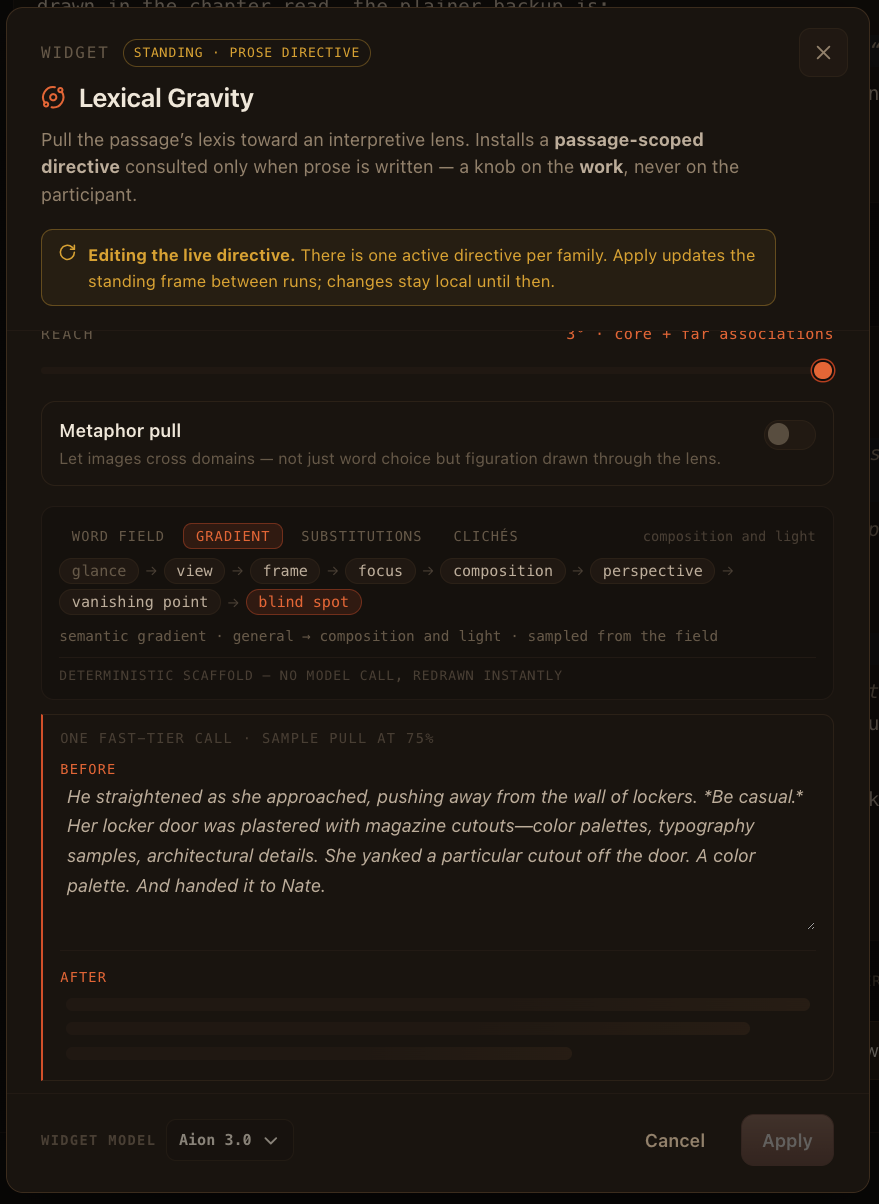
Inspect the field before it touches anything.
Four tabs expose what the directive actually carries — word field, gradient, substitutions, clichés. The gradient is a deterministic scaffold, redrawn instantly with no model call:
One fast-tier call previews the pull on a real passage — sample pull at 75% — before the writer commits anything to the room.
Apply — and the directive rides the room.
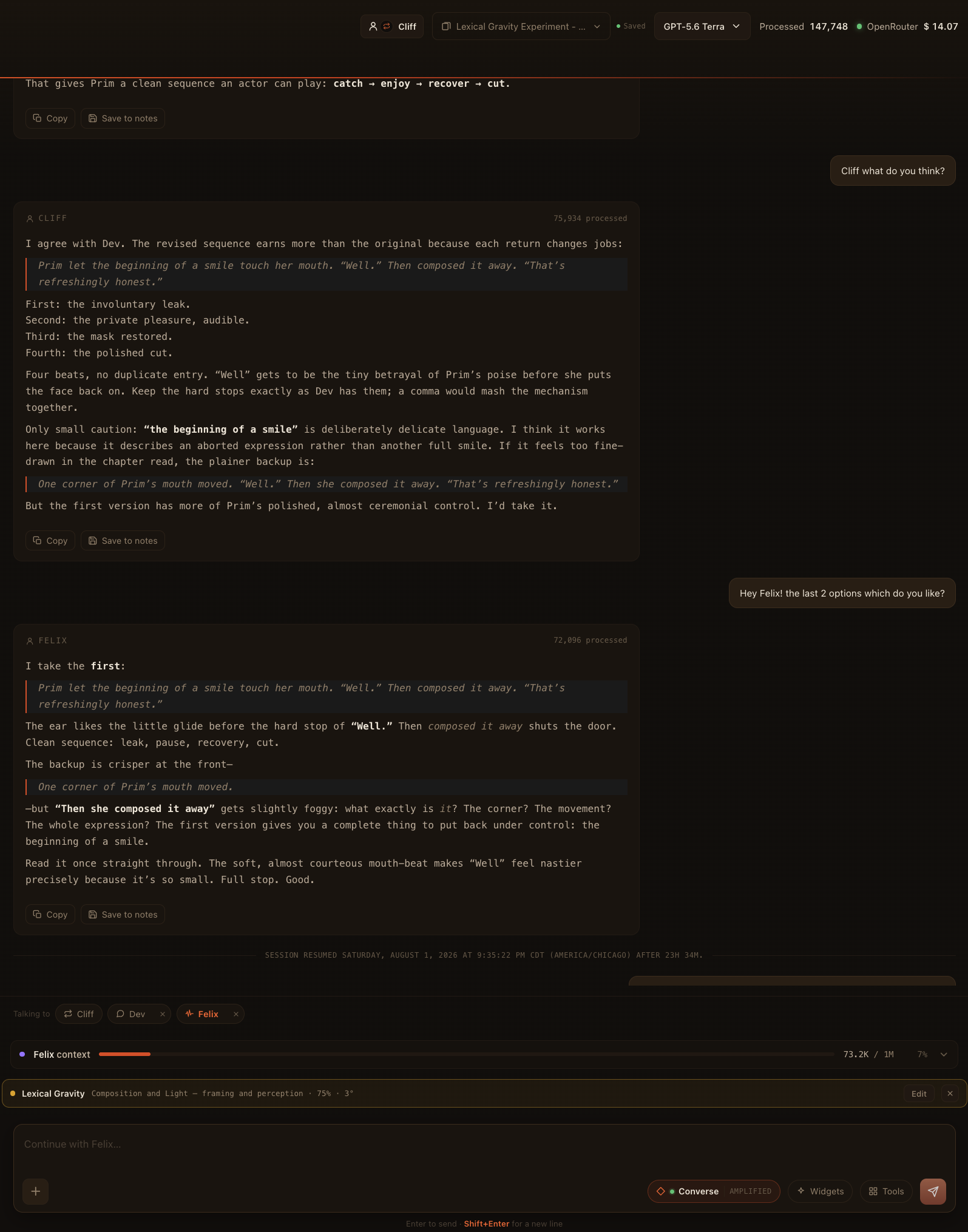
One active directive per family, standing between runs. The chip at the foot of the session — Composition and Light — framing and perception · 75% · 3° — stays visible, editable, killable. Under it, the room workshops a beat of Prim's poise, and the framing vocabulary surfaces on its own: the held breath, the beat of silence, the face put back on.

The lens tilts attention, not verdicts.
Cliff and Felix weigh the same two lines and disagree in their own voices — but both read the beat as a sequence of framed moments: leak, pause, recovery, cut. The field changed what they notice; the scene still decides what wins. That's the accountability test passing.
The goal is not weirdness.
Push it too hard and the prose begins replacing perfectly good verbs with technically adjacent but emotionally false ones. The result may be more unusual without becoming more precise. It may make every sentence sound as though it has just discovered metaphors and is very excited to tell you.
The lens must remain accountable to the scene. A lexical field should not overwrite character voice, genre, or clarity — it should give them another source of energy. The goal is to interrupt the easy return to average language: not randomly, but in a territory chosen for the emotional and perceptual possibilities it offers.
Maybe that means a hallway comes into focus. Maybe a withheld joke lands like a dropped note in a piece of music. Maybe a room does not feel "tense," but like the air before a storm, every person waiting to learn which direction the pressure will break. The writer still decides what belongs.
Does it sharpen what the viewpoint character would notice?
Does it create a useful implication?
Does it add pressure, atmosphere, or specificity?
Or is it simply wearing a costume?
The clichés tab exists for the same reason: the widget maps the stock renderings near the field so the pull doesn't land on them by default.
Conceptual cousins, honestly labeled.
Syntactic and Semantic Control of LLMs via Sequential Monte Carlo
Frames controlled generation as probabilistic conditioning: adding constraints changes the distribution text is generated from. Lexical gravity is not their algorithm — it's a writer-facing prompting procedure — but the shared premise holds: structured constraints can move generation away from the base model's default distribution.
Steering Language Models with Activation Engineering
Demonstrates that targeted intervention at inference time can steer high-level output properties like sentiment and topic. A conceptual cousin: gravity works through prompt, context, and lexical weighting — not internal activation vectors.
"Gravity" here is an interface metaphor for weighted lexical influence — a prompting and product-design experiment, not a decoding algorithm and not a claim of altering activations or token probabilities directly. The research is relevant because it studies neighboring problems: overly typical outputs, controlled generation, and what it takes to move a model off its default distribution.
Semantic runways
Widen the interpretive space before a creative decision. Change what ideas feel available.
Lexical gravity
Give the resulting prose a directional pull as it's written. Change what language feels natural.
"Be more creative" is not a method. It is a wish made while throwing a coin into a fountain.
I initially approached lexical gravity as a weighted vocabulary field. I'm increasingly convinced the vocabulary is only the final layer. A useful lens also carries assumptions about attention, relationship, transformation, and consequence — not only which words belong near one another, but what kinds of changes those words make meaningful. I'm exploring that next: how an interpretive lens can help a model create not just more distinctive prose, but moments that leave a reader expecting something to matter.
Part II: lens logic and narrative charge →If a model's first instinct is to retrieve the most familiar phrase, a weighted lexical field helps it begin somewhere else. Lexical gravity makes a larger — and more interesting — portion of the language visible.