Better gestures with semantic runways.
by: Okey Landers
Ask a model for alternatives to a tired gesture and you get the same drama in different hats. This case study follows one four-word beat — "She pinched her face." — through a deliberate, writer-facing exploration of its meaning-space before any suggestions arrive, and shows what that buys.
Thought? What thoughts?
So much of the work that drives a model toward a particular suggestion happens somewhere the writer can't see. You can ask for ideas. You can give constraints. You can say be more creative — which is about as useful as workshopping a scene with someone who only communicates in final drafts passed under a locked door.
The problem is not that the model has no ideas. It is that it retrieves the most statistically central ones first — the fluent, familiar, center-of-the-bell-curve response. Researchers call the tendency mode collapse, and it is partly a typicality problem baked in by how models are rewarded.
In a human back-and-forth, the "how we each think" exchange matters. You can tell an editor: "Don't read this as defiance. Read it as containment." They can try on that interpretation and bring back a different solution. With a model, that middle space is mostly invisible.
Five phrasings, one dramatic move: generic resistance. The vocabulary varies; the search space never expanded. Asking for "more creative" gets stranger words — not a different solution.
wearing different hats.
Lexical gravity
A weighted word field that gradually pulls prose away from the model's vanilla default lexicon. It changes what language feels natural.
Semantic runways
A frontloaded, writer-facing exploration of the meaning-space around a request, before any ideas are generated. It changes what ideas feel available.
Lexical gravity pulls the model out of its vanilla lexicon center. Semantic runways pull it out of its vanilla reasoning center. Same enemy, two fronts.
Change the question before the answer arrives.
A semantic runway is not private reasoning, and not padding. It is a visible middle space — a taxi-length exploration of the territory — laid down before the model generates and selects from a wider set of possible moves.
One beat under the microscope: “She pinched her face.”
Kayla has just accidentally admitted she might want to ogle Jasper. Prim caught it, Ava is watching, and the storm hands her a cover line. The gesture sits at the hinge between confession and recovery.
Thunder cracked directly overhead. The windows rattled. The lights strobed, and in the flash Nate caught Kayla's face—mouth barely open, eyes fixed on nothing—and it looked like one of his sketches. The unfinished kind. The ones where the expression hasn't decided what it is yet.
"Storm's here," Ava said quietly.
She was watching Kayla.
"Yeah." Kayla pinched her face. "Storm's here."
The phrase is imprecise about placement, force, and intent — and its vagueness blurs the physical image at the exact moment the prose turns visually sharp.
Kayla's exposure after the accidental confession
Her attempt to regain command — incomplete, not polished
Nate's close observational access to her expression
"Yeah. Storm's here" working as a cover, not a true response
A public setting — Prim gets no obvious collapse to enjoy
Kayla's movement-to-stillness vulnerability tell
Eighteen passes over four words, before a single suggestion.
The Gesture Dictionary is the runway made concrete: a craft scan of the target phrase across every dimension that matters, produced first and kept visible. This is what it actually covered for "She pinched her face."
Plus two traps: the anatomy inventory (open mouth + wide eyes + blush + lip bite) and the adverb patch (pinched her face awkwardly).
Six of these ladders were run — subtle→overt, controlled→involuntary, private→public, static→kinetic, restored→leaking, command→exposed. The target sits mid-ladder on all of them: caught, not collapsing.
The runway also flags what the scene blocks: no organizing the notes back to neatness (Prim's dropped-page beat needs them disordered), no big gestures, no mind-reading past Nate's POV.
By the time options are generated, the question is no longer "what are synonyms for this gesture?"
From gravity to gesture menu, in one sitting.
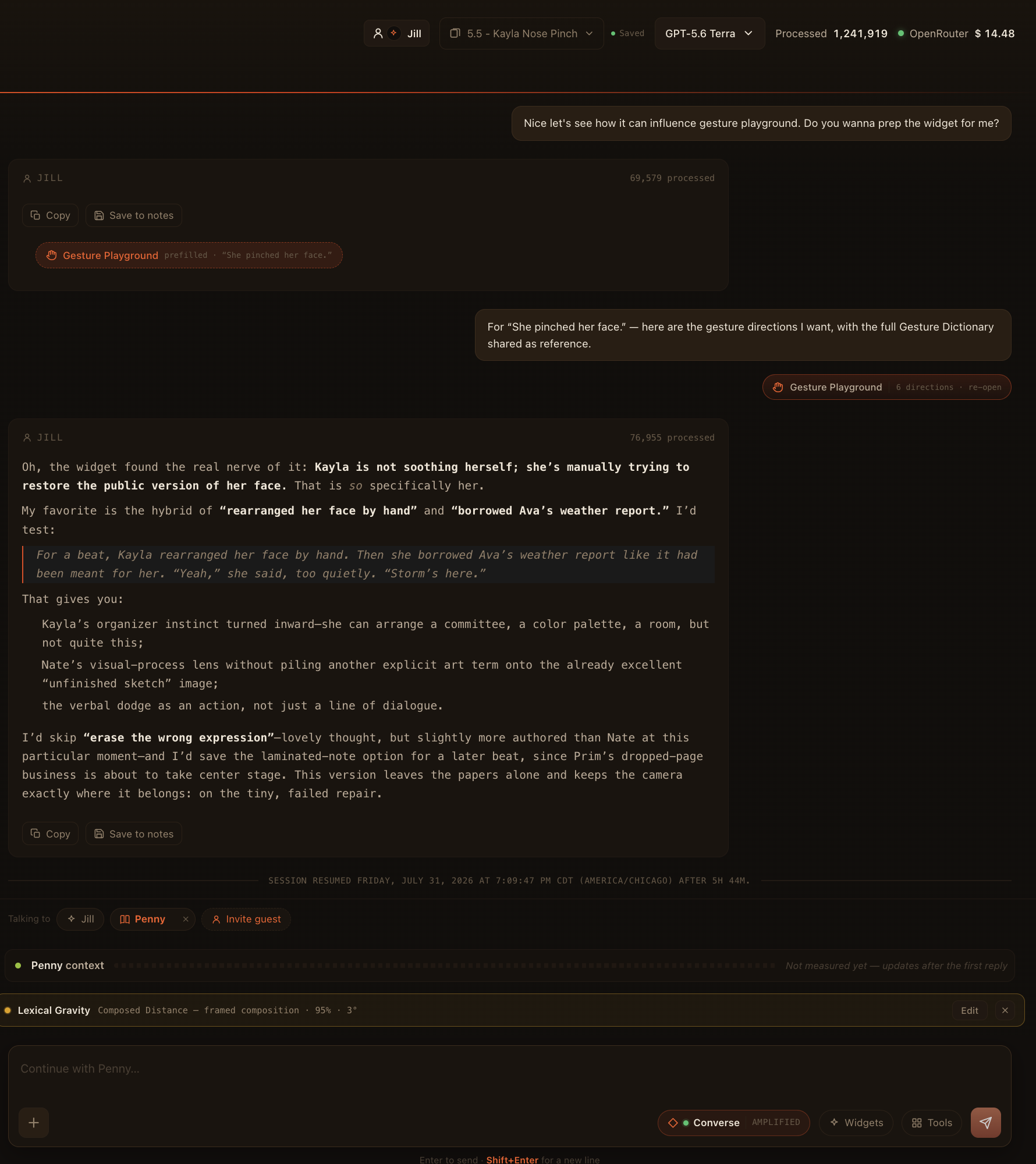
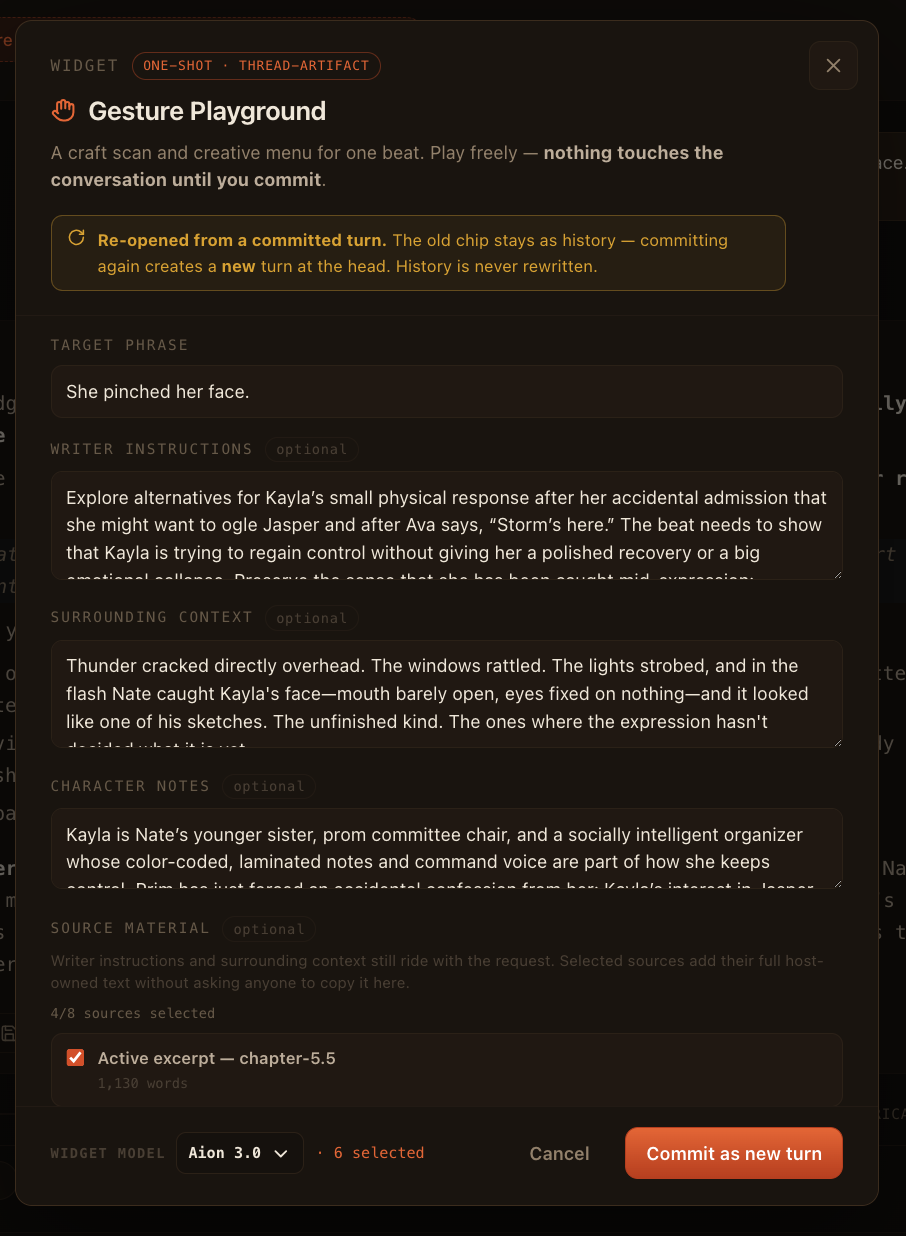
Screens from the working session: a lexical gravity already installed on the room, the Gesture Playground widget prepped mid-conversation, and the runway-backed menu it returned.
Prep the widget mid-conversation.
The Gesture Playground is a one-shot, thread-artifact widget: the assistant prefills it with the target phrase, and nothing touches the conversation until the writer commits. The chip rides in the thread — re-openable, with history never rewritten.
Aim it at one beat.
Target phrase, writer instructions, surrounding context, character notes — and source material delivered host-side, so a 1,130-word excerpt rides along without pasting. This is where the writer's interpretation enters before generation: "regaining control without a polished recovery or a big emotional collapse."
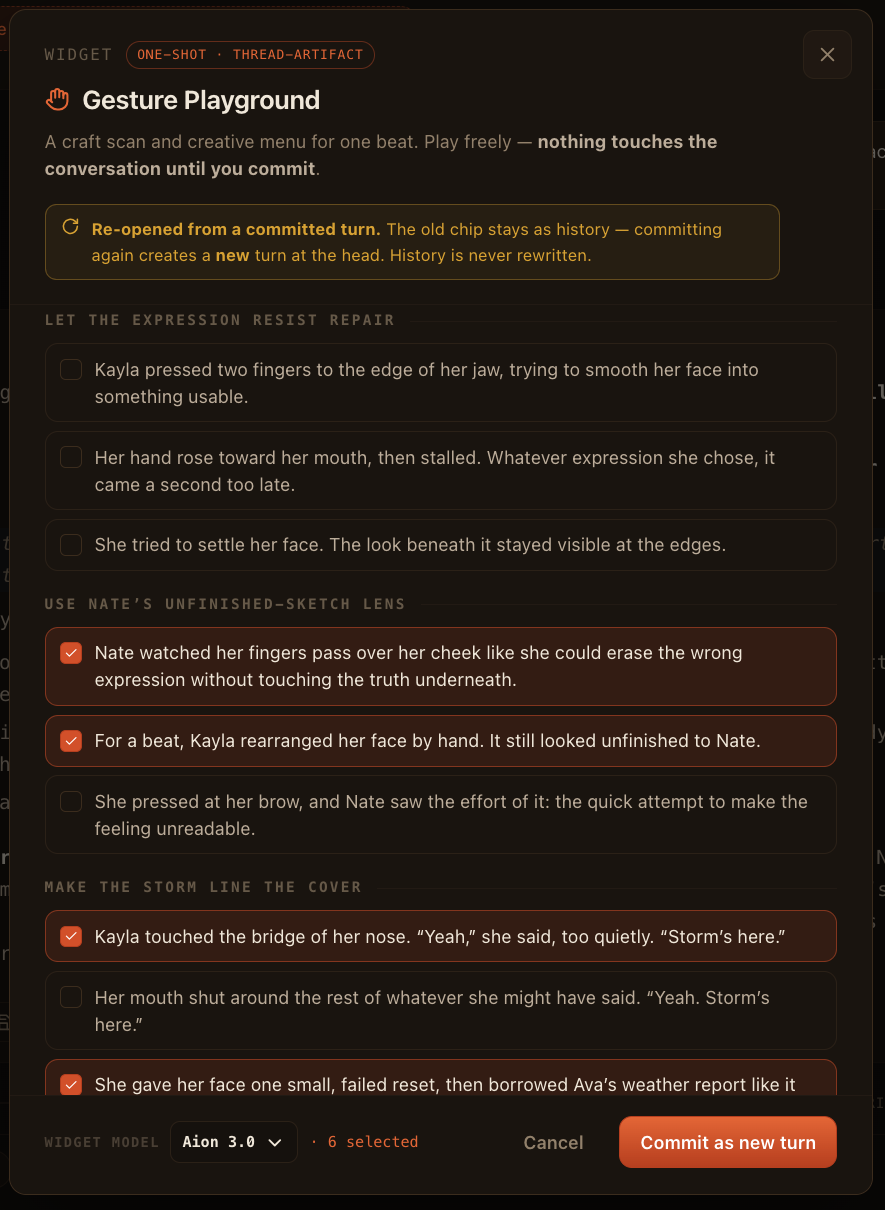
The menu comes back in dramatic jobs.
Not a list of synonyms — named directions, each a different place the pressure can live: let the expression resist repair · use Nate's unfinished-sketch lens · make the storm line the cover. Three drafted lines under each.
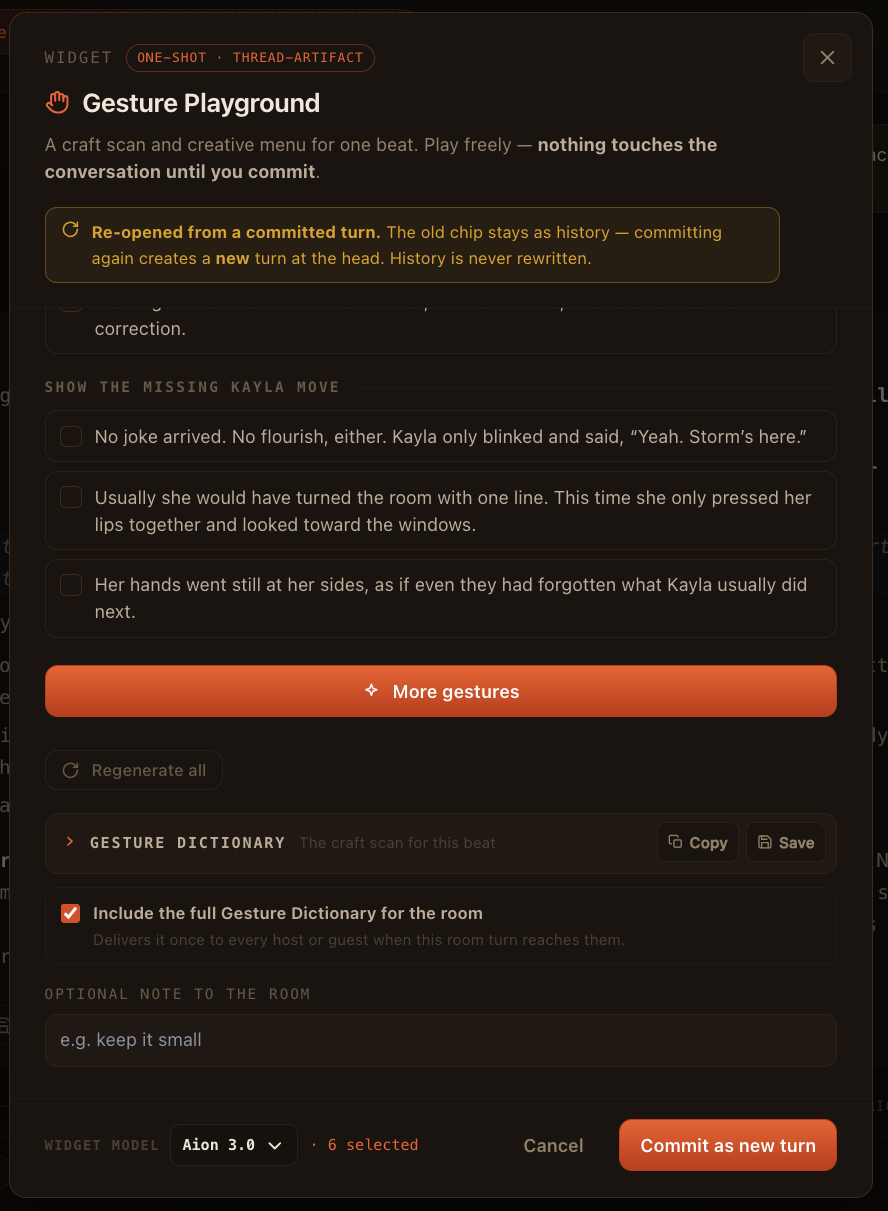
Different kinds of choice.
Further down the menu the gesture stops being a face at all: control leaks into the laminated notes, or the beat becomes negative space — the joke that doesn't arrive. Six versions of six choices, not six hats on one.

Commit — and the runway rides along.
Six selections commit as a new turn. The full Gesture Dictionary — the runway itself — can be copied, saved, or delivered once to every host and guest in the room. The exploration isn't discarded scaffolding; it's a shareable artifact.
The camera lands on the tiny, failed repair.
"Yeah." She pinched her face. "Storm's here."
Serviceable — but vague anatomy at the scene's sharpest visual moment, and a stock reset move.
Kayla gave her face one small reset. It didn’t take. “Yeah,” she said, barely above a whisper. “Storm’s here.”
Landed from the committed direction “she gave her face one small, failed reset” — the failed repair as its own sentence, and the whisper carrying the exposure.
Kayla's organizer instinct turned inward — she can arrange a committee, a color palette, a room, but not quite this.
Nate's visual-process lens without piling another explicit art term onto the already-working "unfinished sketch" image.
The verbal dodge as an action, not just a line of dialogue — and the laminated notes stay untouched for Prim's next beat.
If the default answer is the average of a thousand familiar moves, the job isn't to ask for a better answer. It's to make more of the space visible before asking the model to choose.